
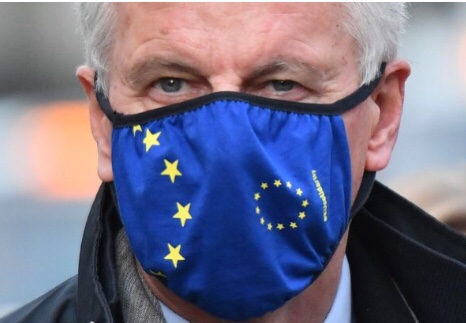
Hello and welcome back to Blog 14 of my Weekly Digest round up of political news and events from N Ireland, UK and USA. I’ve titled this week’s blog ‘ better late than never’, as, well, it’s being published a day or so later than usual, and, it seems appropriate given some of the events this week! In the always shifting sands of political developments, this week’s focus is mainly on what’s been happening at UK level in Westminster, at No.10, and in those crunch trade negotiations with Brussels. As always, however, we’ll begin right here in NI!
After the previous week’s chaotic and often farcical trials and tribulations within the NI Executive, we experienced something of a quiet week. However, the repercussions of the Executive’s dysfunctional and fractured decision making processes will continue to reverberate for some time to come. Firstly, there was the fatally flawed approach to agreeing a coherent and consensual strategy to combat Covid-19. The lack of agreement and total absence of anything resembling collective responsibility ensured a delayed and heavily compromised set of half-way house anti-Covid measures. These have singularly failed to have the desired effects, both in terms of addressing the R-rate of community transmission and, crucially, in fully engaging widespread support and buy-in from an increasingly sceptical and confused NI public! Arguably, therefore, the Executive’s failure to act quickly enough has jeopardised not only the many local businesses that rely heavily on the pre-Xmas trading bonanza, but perhaps even Christmas itself! The decision to fully re-open non-essential retail and close contact personal services, such as beauticians and hairdressers for a week, before closing them again for another fortnight, has been widely criticised for being a contradictory and confusing mishmash which will not address either business concerns nor contain the spread of the virus sufficiently to allow people to have a ‘normal’ Christmas !

Secondly, all of the Executive shenanigans throws up serious questions about the very future operation of the NI Assembly itself. At the very least, this could herald the death knell for mandatory coalition in the near future, and if so, would that necessarily be such a bad thing? Would a voluntary coalition work any better and which party or parties would gain advantage from such a move? Justice Minister and Alliance Party Leader, Naomi Long, made her thoughts very clear in a communication to the party faithful last week: “Let’s be clear: the only way to overcome the failures of leadership we have witnessed at the Executive in recent days is by ending mandatory coalition and breaking the governance structures that have held Northern Ireland back for far too long.” The Alliance may be among the chief beneficiaries under a voluntary coalition. Although they currently hold the Justice Ministry outside of the usual d’Hondt appointment mechanism, by virtue of the fact that SF and the DUP could not countenance letting each other have it, they have also lost out somewhat under the community designations and cross-community voting arrangements within the Assembly. Conversely, the biggest losers under voluntary coalition could well be the DUP, as they would find it difficult to find enough common ground with other parties, as evidenced by the recent group dynamics within the Executive! The Alliance could find themselves in the power broker seat, just as they have been in Belfast City Council chamber. This could result in an acceleration of recent electoral gains for them, too, as they would profit from the increased profile and relevance at the heart of government. It should be pointed out that the Belfast/Good Friday Agreement made provisions for such a transition from mandatory to voluntary coalition, when the time was right. Many are thinking that time has now come. We shall see!

And so to Westminster, where it’s been another very busy and eventful week, politically speaking. Brexit has reared it’s ugly head again, as the deadline to reach a trade deal with the EU draws ever closer. There are, of course, potentially profound implications for businesses and consumers in N Ireland, in particular, due to the imminent introduction of a customs border down the Irish Sea! This could mean customs tariffs for goods entering NI from GB, and ultimately, higher prices for NI consumers! This is high stakes poker between the UK and the EU and we’re caught in the middle and seen merely as collateral but acceptable damage, unfortunately! One of the most interminable and intractable issues appears to be in relation fishing rights and quotas in UK waters. I’m not entirely sure why it’s such a deal breaker, to be honest, as there has been a 32% decline in the size of the UK fleet since 1996, and it contributes less than 1% of the UK economy, so it’s certainly not the industry it once was!

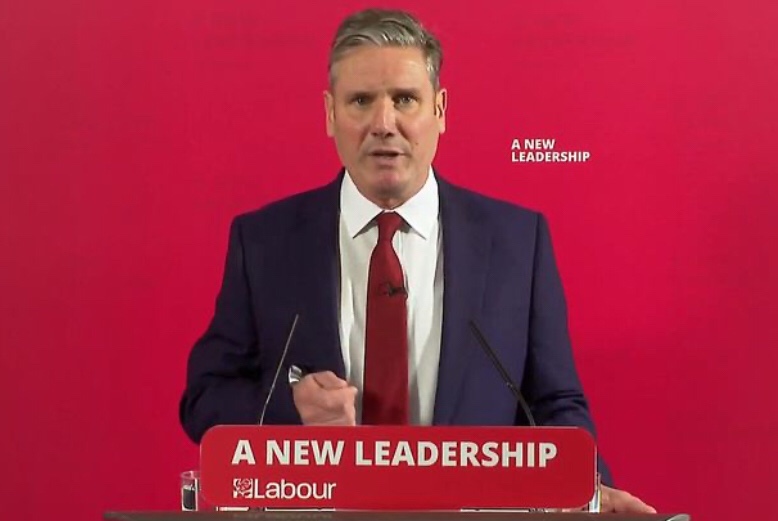
Labour and Keir Starmer will also have a big judgement call to make on this and another key vote in parliament this week regarding Boris Johnson’s new 3-tier lockdown system, which is facing a back-bench Tory rebellion. Environment Secretary George Eustice confirmed that as many as 100 Conservative MPs could rebel against the Government and the result of the vote was now in Labour’s hands.
Politically, Starmer has everything to gain by lending the Government Labour’s support. A final decision will be made after Starmer speaks to Chris Whitty, the chief medical officer, and Patrick Vallance, the chief scientist, today. Although it is always tempting to inflict a defeat on your opponent, it is expected that Starmer will whip his MPs to be cooperative.
The more problematic issue for Starmer is what Labour will do if there is actually a Brexit deal to be put to the House. If Starmer opts to back the deal, then several Labour frontbenchers have already indicated they will resign. It would also mean that Labour has part ownership should the deal prove to be unsatisfactory and the country nosedives, economically, as many analysts are forecasting. The other options are to vote against or abstain. Voting against would allow Johnson to paint Starmer as a stubborn Remainer who still does not understand why voters in the northern Red Wall constituencies turned their backs on Labour. Abstaining on the biggest political question this country has wrestled with in a generation may also look chronically indecisive. Who’d be a party leader, eh? 🤷🏻♂️
In what appeared to be great news, initially, the team developing the Oxford University vaccine released it’s trial findings this week which showed it to be 70% effective, but a little worryingly, it was not as effective as the previously released Pfizer or Moderna vaccine trials, which showed up to 95% efficacy. This has potentially huge implications for the UK government, which has put most of their eggs in this particular basket in terms of vaccine investment. Interestingly, the trials also showed that the Oxford and AstraZeneca vaccine can be up to 90% effective if a second dose is administered after giving an initial half dose. A further trial will be required, however, to confirm this, which may waste further precious time! So, the results may be considered both a triumph and a slight disappointment, following very successful trials by Pfizer and Moderna, depending on how you look at it. If it does eventually all work out, it will be far cheaper and easier to store than other successful vaccines, meaning it will likely play a big part in fighting the pandemic globally if approved. Boris Johnson et al, will be keeping all fingers and toes crossed for a successful outcome! 🤞🏻

Probably the biggest news of the week in the UK was Rishi Sunak’s anticipated announcement of his dreaded Spending Review. Inevitably, there would be some hard nosed and controversial decisions to be made! Here is a very brief summary of the highlights/lowlights, depending on your view! Warning – there are some eye watering figures involved!
- The budget deficit will be £394bn this year, or 19% of GDP – the highest level in peacetime.
- The national debt – the sum total of every budget deficit – of £2.2tn in 2020-21, or 104.1% of GDP.
- Pay rises for the public sector will be frozen next year, with the exception of more than 1 million NHS staff.
- 2.1 million public sector workers who earn below £24,000 will be get a pay rise of at least £250.
- The national living wage will be increased to £8.91 an hour, and extended to over-21s. (That’s just 14p per hour, btw!)
- Unemployment is forecast to peak next year at 7.5%.
- Sunak says day-to-day departmental spending will rise in real terms by 3.8%, the fastest growth rate in 15 years.
- The government will match EU funding for regional development after Brexit, apparently. Funding for communities to pilot programmes will be made next year.
- The core health budget will grow by £6.6bn. The chancellor says this will help to hire 50,000 new nurses.
- The schools budget will increase by £2.2bn.
- The government will cut the overseas aid budget to 0.5% from 0.7% in 2021, allocating £10bn at this spending review.
- Investment in infrastructure will total £100bn next year, with plans to deliver the highest levels of sustained investment in 40 years.
- The chancellor announced a new £4bn fund for “levelling up”, to which any local area can bid for the funding of local projects.
The most controversial aspects of this review, apart from the gargantuan levels of borrowing and debt being accrued, would be the public sector pay freeze for millions of workers and the cutting of the overseas aid budget. The latter attracted ardent criticism from across the political spectrum from politicians who felt that the UK was reneging on vital overseas aid commitments that will potentially adversely affect the lives of millions of impoverished people. It even led to the resignation of a Tory junior Minister in the Foreign Office – Baroness Sugg! For Sunak, the message was clear – charity begins at home, for now! That would be a lot easier to accept if it weren’t coming from a government who were recently refusing to extend the free school meals scheme for children from low income backgrounds!
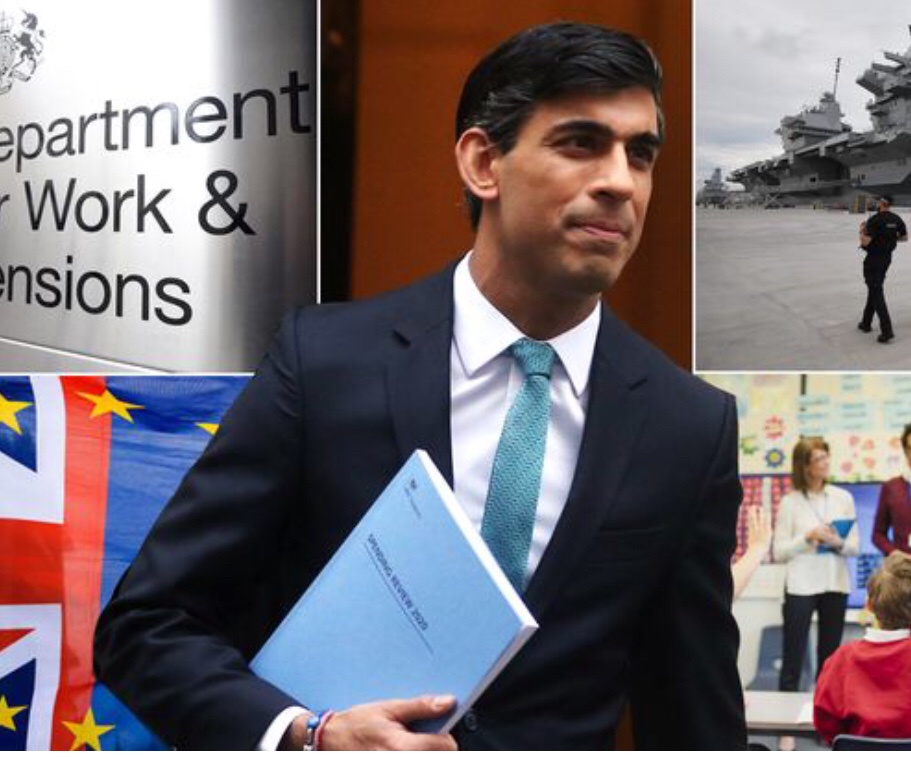
And sticking with affairs of the purse, it has been revealed that Rishi Sunak’s wife has shares in her family’s tech firm that are worth £430million, making her one of Britain’s wealthiest women. Even richer than the Queen!
Why is this important? Well, Akshata Murthy’s multimillion pound portfolio of shares have come to light amid questions as to why the Chancellor failed to declare them in the register of ministers’ interests. This is just the latest revelation, coming after Sunak faced demands to reveal details of his financial interests last month, after it emerged he set up a ‘blind trust’ when he was made Chief Secretary to the Treasury in July last year. But critics said there was still a risk of conflicts of interest, as Sunak – reputed to be the UK’s richest MP – is well aware of what he put into the trust. Looks like the financially shrewd Sunak wasn’t made the Chancellor of the Exchequer for nothing!

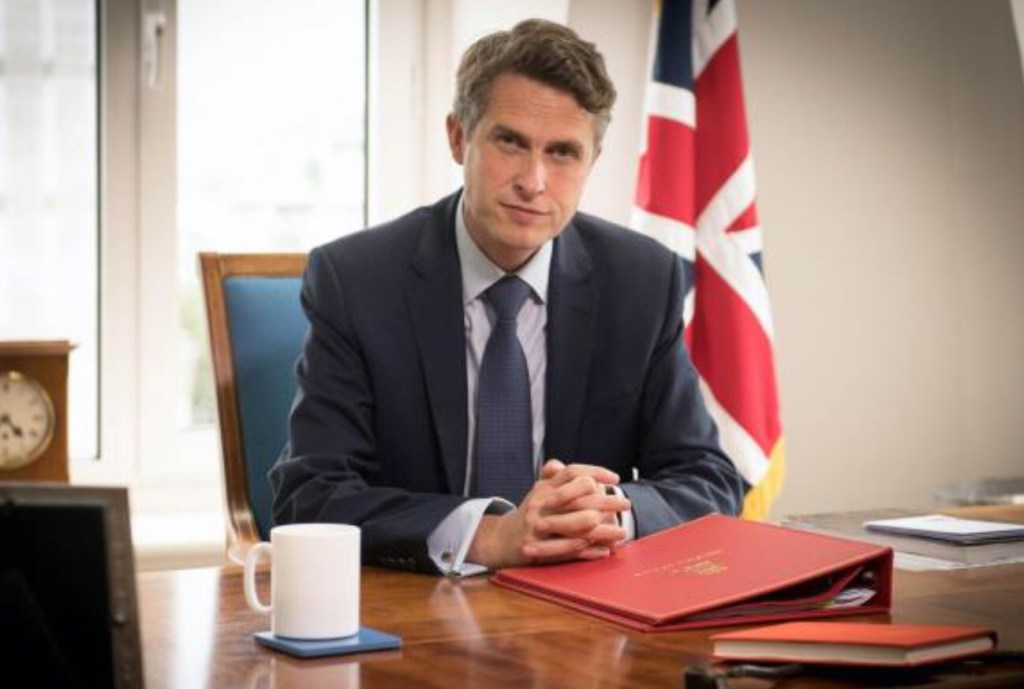
Another Conservative Minister was being criticised this week, too, after losing a court appeal. In a great example of politicians being held to account by the judiciary, Gavin Williamson, the Education Secretary, was adjudged to have unlawfully removed safeguards for children at the start of the coronavirus pandemic – without consulting children’s rights organisations.
Children’s rights charity Article 39 launched a legal challenge after the Department for Education removed or watered down 65 distinct legal protections designed to protect nearly 80,000 children in care in England, during lockdown. They included six-monthly reviews of children’s welfare, independent scrutiny of children’s homes, timescales for visits to children in care by social workers and oversight of adoption decision-making.
But the court of appeal, in a judgement handed down on Tuesday, said Williamson should have consulted the children’s commissioner for England – as well as other bodies representing the rights of children in care before introducing the changes. Not a good week for Gav, then!
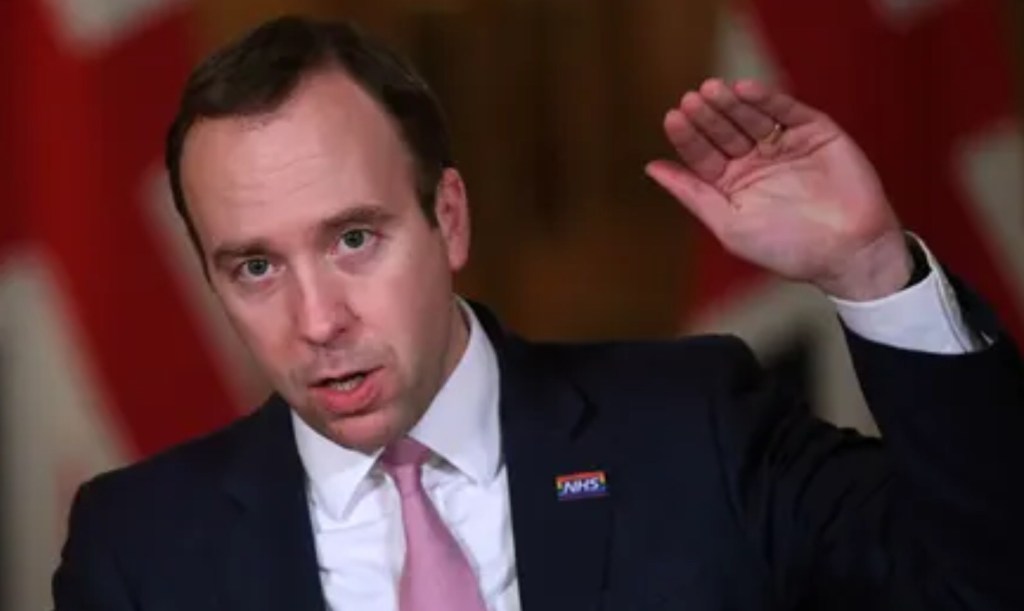
Yet another Tory Minister in hot water this week was Health Secretary, Matt Hancock, who failed to declare that he appointed his closest friend from university as an adviser and later gave her a £15,000-a-year role on the board of the Department of Health and Social Care (DHSC). Gina Coladangelo was secretly appointed in March – at the height of the pandemic – as an unpaid adviser on a six-month contract. She has since accompanied Mr Hancock to confidential meetings with civil servants and been seen at 10 Downing Street. Ms Coladangelo, 42, is a director and major shareholder at Luther Pendragon, a lobbying firm based in central London that offers clients a “deep understanding of the mechanics of government”. Well, indeed! And wasn’t it ever so lucky that she has a bezzie mate who just happens to be the Health Secretary and who had no qualms about letting her have an ‘access all areas’ pass!
Okay, enough of all this anti-democratic cronyism in the UK. Let’s head over to that bastion of democratic values that is the USA! What, with Trump at the helm, I hear you ask? Well, yes, actually! The checks and balances within the US system, in place since the signing of the US Constitution, have done their job in protecting the integrity of the US election and in preventing Donald Trump’s crass, anti-democratic power grab attempts! Great, yes, but this does come with a health warning for the future!
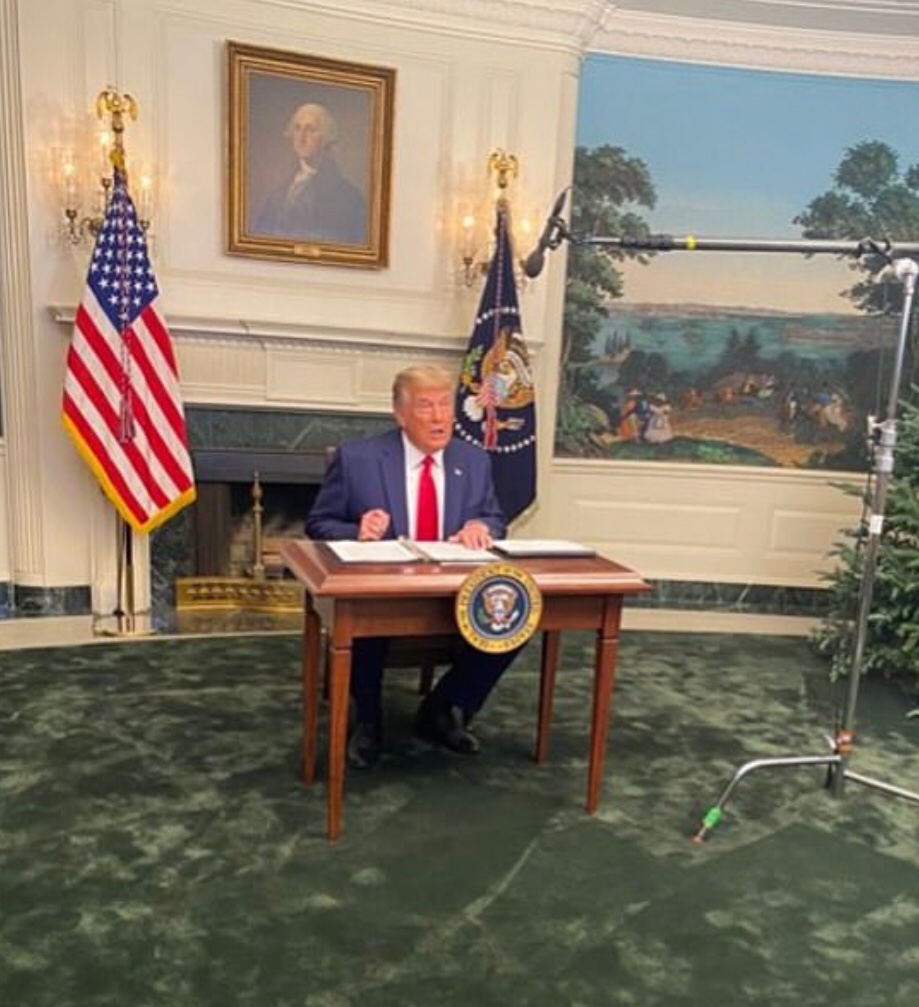
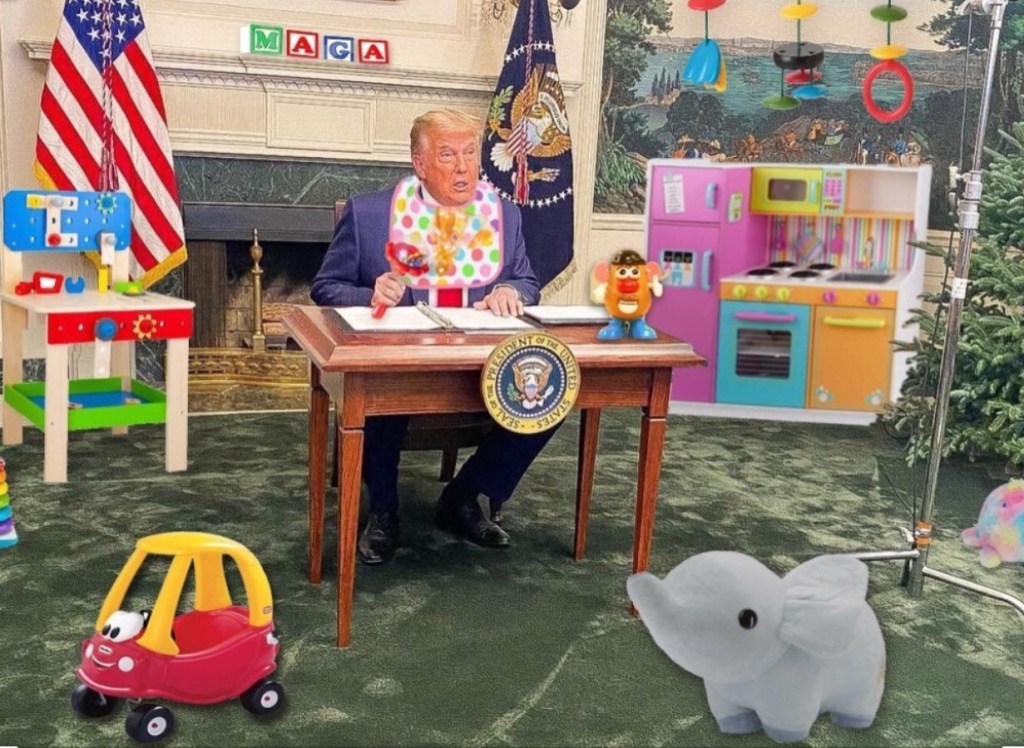
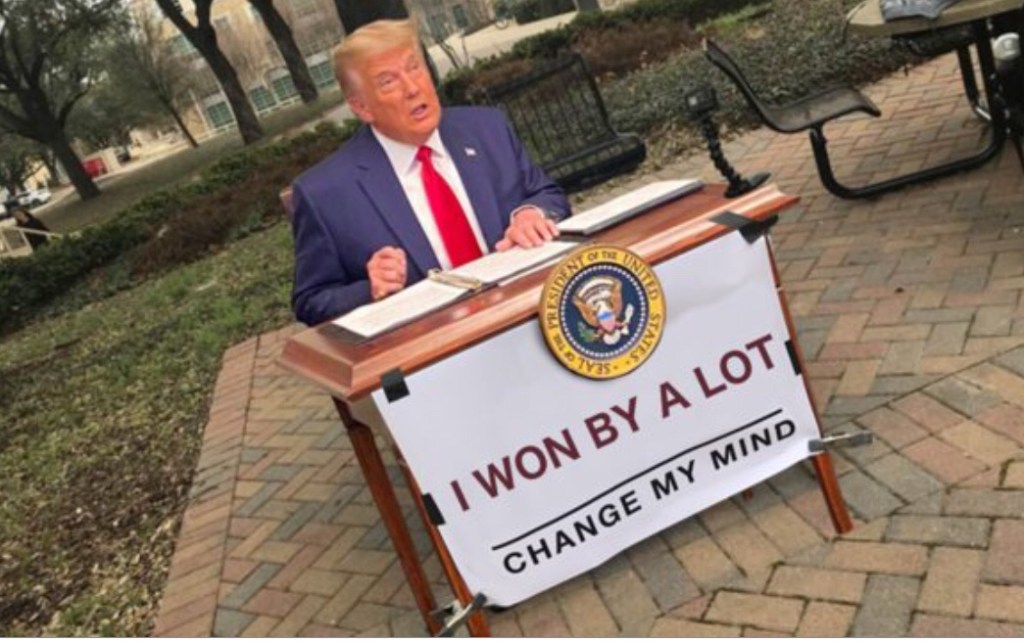
Journalist, Kaitlyn Collins, has been a long-time media nemesis of the Trump administration. The CNN reporter on Thanksgiving tweeted a photo of Trump at his tiny desk. The picture very quickly went viral, of course, with people saying it looked like a child’s table. The phrase ‘Diaper Don’ began trending within hours! This may all seem a little trivial and infantile but that’s precisely the point. It’s the perfect metaphor for the prolonged tantrum that is the end of Trump’s presidency! Here is the actual picture, plus one of the many photoshopped memes that are doing the rounds!
The real killer blow to Trump’s chaotic presidency came late Monday afternoon, however, when a previously obscure US government official, Emily Murphy, finally initiated the official presidential transition – nearly three weeks after Joe Biden won the election. Meanwhile, the outgoing President’s ridiculous legal challenges are crumbling, key states keep certifying his election defeat and President-elect, Biden, has started naming his key Executive appointments, including a former Presidential candidate and former Secretary of State, John Kerry, who has been appointed the Special Climate Envoy! Anthony Blinken, who once described Brexit as like “a dog being run over by a car – a total mess!”, has been appointed as Secretary of State! That may not bode well for Boris Johnson’s hopes of securing a favourable UK-US trade deal!
The transition unleashes millions of dollars in funds for the President-elect to prepare for power and compels the current administration to brief the incoming team. That doesn’t necessarily mean Trump himself will cooperate with the transition, though. In a face-saving tweet, the President insisted that it was he who had ordered Murphy to begin the transfer of power — but his remaining two months in office leave him plenty of time to try to sabotage Biden’s administration.
We may never get a formal concession from Trump, who’s likely to walk out of the Oval Office in January still insisting the election was stolen. But the basic foundation of American democracy appears to have weathered the storm and narrowly survived him. The state and local officials and judges who resoundingly rejected Trump’s attempts to subvert democracy and invalidate millions of votes have undoubtedly rescued American democracy from the mouth of the dustbin. The scariest thought, however, is just what would have happened if there had been a competent and smart would-be populist dictator, rather than the hapless Trump? This is a question that all Americans who purport to defend democracy and its values should be asking themselves. They also need to find ways of addressing the widespread disaffection that gave rise to Trump in the first place!
That’s all for this week, folks! The blog was published a bit later this week, due to some issues beyond my control, but I hope it was a case of better late than never. Until next time, then, stay tuned in, stay informed and stay safe! Now, here’s another one of those Trump memes to sign off on! 😂👍🏻
 The Weekly Politics Digest!